


The spinning wheel and bouncing ball have commanded casino floors for centuries. Today, the digital frontier brings this iconic mathematical engine directly to your screen. Whether you are a newcomer deciphering the board or a veteran advantage player optimizing your edge, Exploring Online Roulette: Interactive Demo Experience is the smartest entry point. It provides a zero-risk sandbox to deconstruct the game’s mechanics and test statistical theories without exposing a single cent of your bankroll.
Engaging with a demo roulette casino strips away the financial anxiety. You set the pace, manipulate wagering models, and build mathematical confidence. Here is how you can weaponize practice modes to engineer a better session.
A Step-by-Step Approach to the Table
The betting grid looks like a chaotic spreadsheet to the untrained eye. Breaking down how to play online roulette for beginners means translating this grid into actionable data. By leaning on a step by step roulette rules guide inside a simulator, that initial confusion morphs into calculated strategy.
The core objective is straightforward: predict the ball’s final resting place. The true game, however, exists in how you structure your risk. When you initialize a roulette demo, the board cleanly splits into two distinct risk profiles.
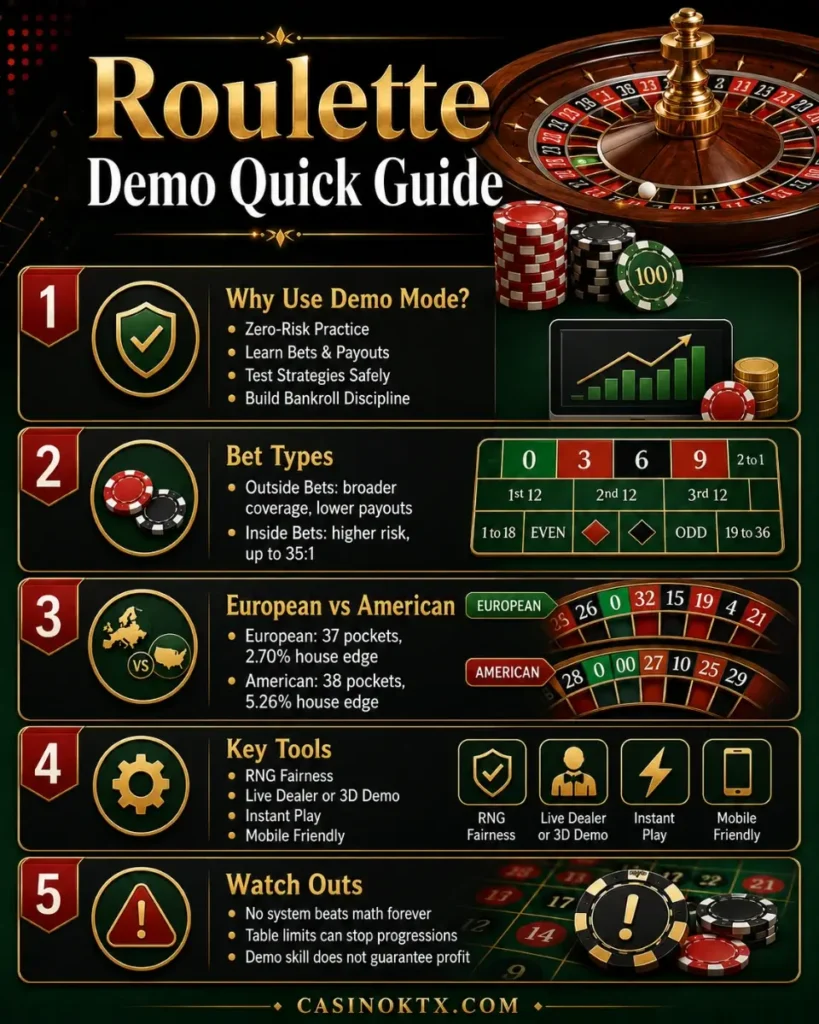
Getting your inside and outside bets explained is the first step in risk management:
- Outside Bets: These sit on the perimeter and cover broad statistical swaths of the board, such as Red/Black, Odd/Even, or High/Low (1-18 or 19-36). Because your probability of hitting is nearly 50%, the payouts are conservative—typically 1:1 or 2:1. These are the mathematical foundation for any beginner’s session.
- Inside Bets: These are surgical strikes. Placed directly on specific numbers or tight clusters (like a single digit, a two-number split, or a four-number corner), the statistical probability plummets, but the upside skyrockets. A straight-up single number hit pays out at a massive 35:1.
Before pushing virtual chips, audit your understanding table limits and payouts. Every table enforces strict minimums and maximums, acting as structural guardrails for how aggressively you can scale your bets. A demo environment lets you slam against these ceilings safely, visualizing how specific payout structures impact your bankroll over time.
Choosing Your Wheel: European vs. American
Not all wheels run the same algorithm. When navigating virtual casino lobbies, you will hit two dominant architectural variations. Identifying the structural difference is the single most important decision a player can make.
When you run the numbers on european vs american roulette odds, the entire mathematical landscape hinges on a single pocket. European roulette operates with 37 pockets (numbers 1-36 plus a single green zero). American roulette injects a 38th pocket—the double zero (00).
That single extra pocket radically corrupts the math for the player. The casino house edge calculation is tied directly to these zeroes. On a European wheel, the house maintains a lean, player-friendly advantage of just 2.70%. The moment you sit at an American table, that double zero spikes the house edge to a punishing 5.26%—nearly double the statistical drag on your capital.
Because the math is undeniably lopsided, analytical players exclusively hunt for the European layout. Firing up a free european roulette practice mode allows you to hardwire your strategies against the most favorable odds on the market before you ever touch a real-money deposit.
The Technology Driving the Experience
For skeptics, the immediate question is always: is online roulette rigged or fair? It is a rational concern when a physical dealer is replaced by lines of code. The guarantee of fairness sits entirely on the shoulders of sophisticated cryptographic technology.
Top-tier gaming studios operate under strict random number generator certification. An RNG is an advanced algorithm generating millions of numeric sequences per second, ensuring each spin is mathematically isolated and independent. Independent auditing agencies stress-test these engines constantly, certifying that the virtual ball’s trajectory is just as volatile and unpredictable as a physical wheel in Monaco.
Visually, the software engineering is staggering. Players now toggle between live dealer vs animated roulette games. Live dealer streams beam a human croupier to your screen in high-definition, merging real-world physics with digital betting interfaces. Conversely, modern animated variants rely entirely on software, handing you total control over the spin rate. These builds deploy cutting-edge realistic 3d roulette graphics, authentic audio tracking, and physics-based collision models that mirror the kinetic energy of a real casino floor.
Strategic Practice and Modern Tools
The digital era’s greatest asset is frictionless access. Today’s infrastructure allows you to launch a no download instant play roulette game directly from your browser in seconds. Whether you are running a multi-monitor desktop setup or swiping through a mobile friendly roulette simulator on a crowded train, enterprise-grade practice software is always online.
This instant access creates the ultimate laboratory for stress-testing betting strategies. Roulette remains a game of independent trials where no system can defeat the math outright, but structured betting systems optimize how you manage variance.
- The Martingale System: A high-risk, exponential scaling strategy. You double your wager after every loss on a 1:1 bet (like Red or Black). The math dictates that a single win recoups all previous losses plus a baseline profit—provided you don’t hit the table limit first.
- The Fibonacci Sequence: A calculated progression model. You increase bets using a strict mathematical sequence (1, 1, 2, 3, 5, 8) following a loss, creating a smoother, less violent bankroll swing than the Martingale.
- The James Bond Strategy: A flat-betting, risk-hedging tactic that covers over 60% of the table to grind out consistent, low-volatility returns.
Deploying these systems with real capital during a cold streak can incinerate your balance in minutes. Executing them in a demo simulator forces you to confront the mathematical volatility safely. Top-tier simulators now integrate advanced interactive bankroll management tools. These dashboards track your win/loss ratios, graph session volatility, and calculate average bet sizing in real-time. Mastering these analytics in a sandbox is the exact discipline required to survive a real-money session.
Final Thoughts
Transitioning from a casual observer to an educated player does not require a financial sacrifice. By leveraging enterprise-grade digital simulators, you can deconstruct the rules, expose the mathematical odds, and push complex betting architectures to their breaking point in a completely secure environment. Boot up the virtual wheel, analyze the data behind every bet type, and engineer a smarter, sharper approach to one of the casino floor’s greatest games.