

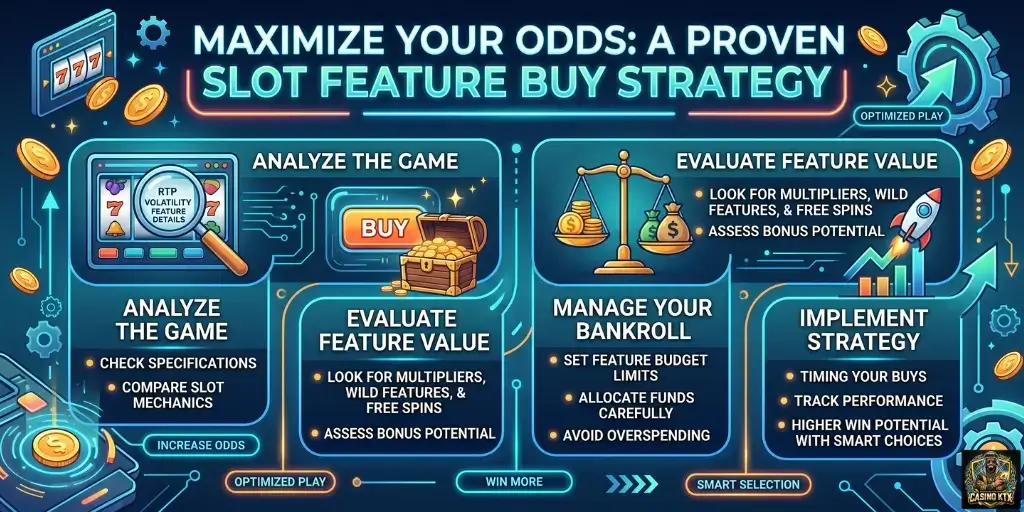
Skipping the base game and jumping straight into the action is the ultimate thrill. But if your slot feature buy strategy relies purely on gut feeling, you are likely burning through your casino bankroll much faster than necessary.
Bonus buy slots have fundamentally changed how players approach online casinos. Instead of spinning 300 times and hoping for three scatter symbols, you pay a premium—usually between 50x and 100x your base bet—to instantly trigger the free spins round.
However, buying the feature does not guarantee a profit. In fact, due to the extreme volatility of these games, the math is entirely different from standard slot spinning. In this guide, we will break down the numbers, analyze the true probabilities, and give you a mathematical approach to buying free spins without ruining your bankroll.
The Math Behind the Buy: RTP vs. Volatility
To build a winning bonus buy slots strategy, you first need to understand what you are actually purchasing. When you buy a feature, two mathematical factors are at play: Return to Player (RTP) and Volatility.
How Feature Buys Alter the RTP
In many modern slot games, utilizing the feature buy button slightly increases the game’s overall RTP. For example, a standard game might have a base RTP of 96.00%. But if you opt to buy the bonus, the RTP might jump to 96.50%.
While a 0.50% increase seems small, in the casino world, any reduction of the house edge is mathematically significant over a large sample size. You are getting a statistically “fairer” bet by buying the bonus than by grinding the base game.
The Volatility Trap
If the RTP is higher, why do so many players go broke playing feature buy slots? The answer is extreme volatility.
When you pay 100x your stake for a bonus round, the payout distribution is highly skewed. Game developers design these bonuses to have massive maximum win potentials (often 5,000x to 20,000x). To fund those massive wins, the vast majority of feature buys must pay out significantly less than they cost.
Here is a realistic probability breakdown of a standard 100x bonus buy on a highly volatile slot:
- 40% probability: The bonus pays back between 0x and 20x (Massive Loss).
- 30% probability: The bonus pays back between 20x and 50x (Moderate Loss).
- 15% probability: The bonus pays back between 50x and 99x (Small Loss).
- 10% probability: The bonus pays back between 100x and 300x (Profit).
- 5% probability (or less): The bonus pays back 300x+ (Massive Profit).
As you can see, you will mathematically lose money on roughly 85% of your feature buys. A successful slot feature buy strategy is not about winning every time; it is about surviving the dead streaks until you hit the 10% to 5% of rounds that actually pay out.
Essential Bonus Buy Bankroll Management
Because of the extreme volatility outlined above, standard bankroll rules do not apply here. If you sit down at a $1 slot machine with $100, you can usually play for a while. If you sit down at a bonus buy slot with $100 and buy one $100 feature, your session could be over in exactly 45 seconds.
If you want to know how to win on feature buy slots, or at least give yourself a mathematical chance to realize the RTP, you must adjust your bankroll depth.
The 30-Buy Rule
To absorb the inevitable string of “dead” bonuses, you need a bankroll that can withstand variance. A professional rule of thumb is to have at least 30 buy-ins for the stake you are playing.
- If you are doing $20 bonus buys (usually a $0.20 base bet), your dedicated bankroll should be $600.
- If you are doing $100 bonus buys (a $1 base bet), your bankroll should be $3,000.
Why 30? Statistically, hitting a 300x to 500x multiplier (the kind of win that puts a session into heavy profit) happens roughly once every 25 to 30 bonuses on a high-volatility game. If you only have enough money for 5 buys, you are relying entirely on short-term luck rather than statistical probability.
Top 3 Slot Feature Buy Strategies
Now that the math and bankroll management are clear, how do you execute a strategy in real-time? Here are three data-driven approaches you can use on your next session.
1. The Hit-and-Run Strategy (Fixed Target)
This is the most effective way to protect your balance. Before you buy your first feature, set a strict profit target—usually between 30% and 50% of your starting bankroll.
Example:
- Starting Bankroll: $500
- Target Profit: +$200 (Total balance $700)
- Strategy: You do $20 feature buys. You hit a decent multiplier on your 4th buy and your balance reaches $715. You stop playing immediately.
The math dictates that the longer you play, the closer your returns will align with the game’s negative expected value (the house edge). By setting a realistic hit-and-run target, you capture the positive variance (short-term luck) and leave before the math corrects itself.
2. The Tiered Buy Strategy (Stepping Up)
This strategy helps mitigate risk early in the session while allowing for larger upside if you run hot.
- Start by doing the lowest possible feature buy the game allows (e.g., $10 or $20).
- If the bonus pays out more than 2x its cost (e.g., you pay $20 and win $45), take the profit and step up to the next buy tier (e.g., $40).
- If the $40 buy loses, drop immediately back down to the $20 tier.
- If the $40 buy wins big, you can either step up again or cash out the session.
This approach ensures that you are only risking larger amounts of money when you are playing with “house money” (accumulated profits), rather than digging deep into your initial deposit.
3. Hunting the Highest RTP Shifts
Not all bonus buys are created equal. As a rule, you should always check the game’s paytable information before purchasing a feature. Look for games where the RTP difference between the base game and the feature buy is the most significant.
For example, standard Megaways titles often feature an RTP jump of 0.40% to 0.60% when buying the bonus. However, some games offer “Super Buys” or multi-tiered bonus buys where the highest tier offers the absolute best mathematical RTP available on that machine. If your bankroll allows for the 30-Buy rule at the highest RTP tier, that is the mathematically optimal play.
3 Fatal Mistakes to Avoid When Buying Free Spins
Even with perfect math, emotional decisions can ruin your session. Avoid these common traps:
- Revenge Buying (Tilt): You buy a $50 feature and it pays $1.20. Frustrated, you immediately buy a $100 feature to win it back. This is emotional betting, not strategic betting. The machine has no memory; a terrible bonus does not mean a great bonus is “due.”
- Playing Low Volatility Slots for Buys: If you are paying 100x your stake, the game must have the potential to pay out 1,000x or more. Buying bonuses on low-volatility games is mathematical suicide, as the maximum win often isn’t high enough to cover the cost of your inevitable losing buys.
- Ignoring the “Cost to Max Win” Ratio: Always look at the game’s maximum win cap. If a feature costs 100x, and the absolute maximum the game can pay is 2,000x, the risk-to-reward ratio is poor. Focus on games where the maximum win is at least 5,000x to 10,000x your base bet, giving you the mathematical upside required to justify the premium purchase price.
Conclusion: Discipline is Your Greatest Asset
The reality of any slot feature buy strategy is that the casino always maintains a mathematical edge. However, by understanding RTP of bonus buy slots, acknowledging the brutal realities of game volatility, and enforcing strict bonus buy bankroll management, you give yourself the best possible chance to walk away a winner.
Stop relying on blind luck. Treat your feature buys like a calculated investment: manage your risk, take profits when the variance swings in your favor, and never chase your losses.
However, even the most mathematically perfect betting system is useless if you are playing on an unreliable platform. Before risking your capital, always consult our trusted online casino reviews to ensure you are depositing on secure, direct web platforms that guarantee authentic RTP, fair RNG mechanics, and zero agent interference.