
Beating the House: The Mathematics Behind Pragmatic Play Volatility

When analyzing modern digital reel architectures, understanding pragmatic play volatility math is the single most critical factor for sustainable session management. While casual players often rely on visual themes or promotional hype, data-driven enthusiasts recognize that every spin governed by a certified Random Number Generator (RNG) operates on strict mathematical probabilities. Mastering these mechanics transforms reel gaming from an unpredictable gamble into a calculated exercise in quantitative risk control.
1. Decoding the Mathematical Engine Behind Slot Volatility
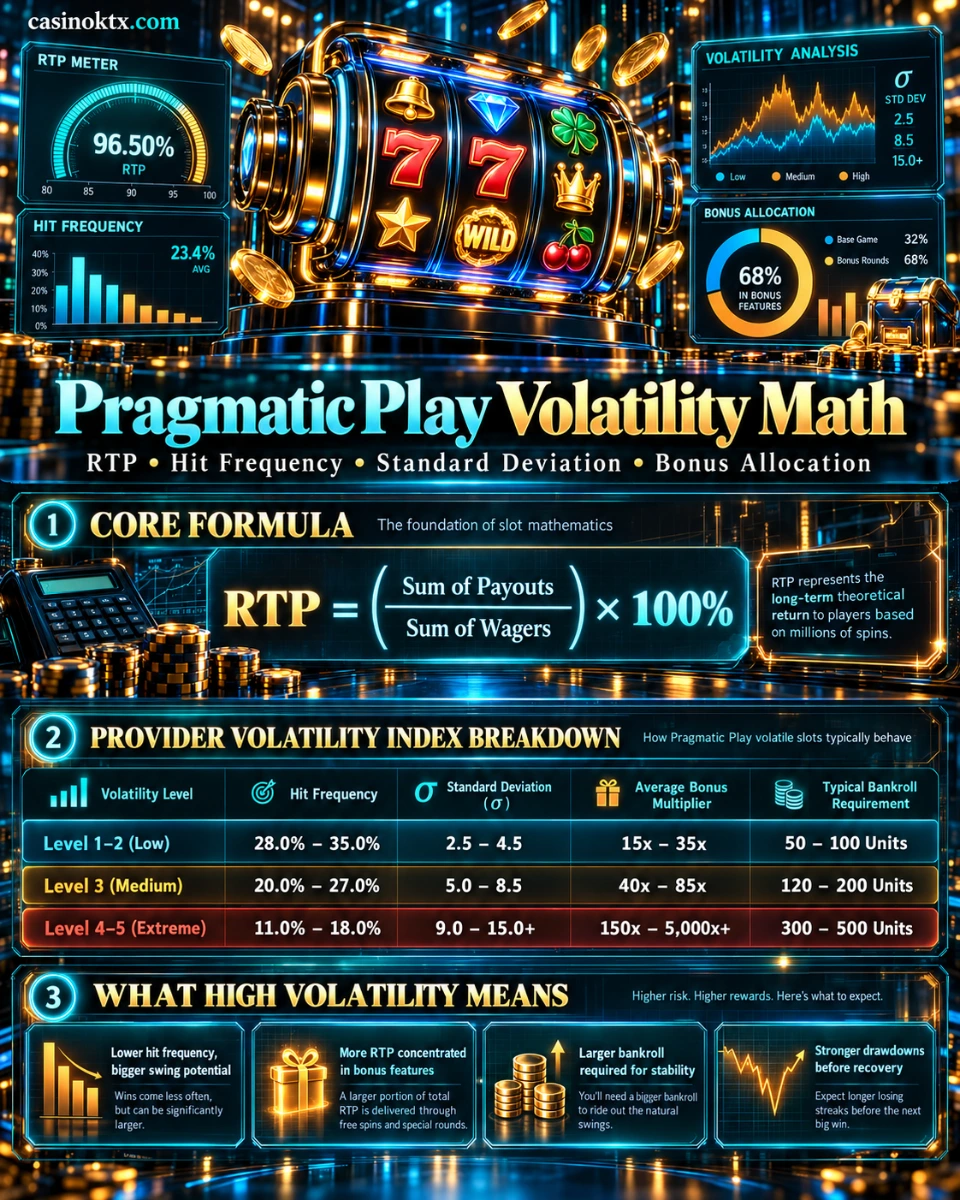
Volatility—frequently referred to as variance—quantifies the statistical dispersion and magnitude of payouts over a massive sample size (typically N ≥ 1,000,000 spins). While the theoretical Return to Player (RTP) defines the overall payout percentage over time, volatility dictates the distribution curve of those returns.
Calculated over long-term statistical spin volume.
When evaluating how to calculate slot volatility, quantitative analysts examine three primary metrics:
- Standard Deviation (σ): Measures the spread of spin outcomes relative to the mean payout. High volatility slots feature standard deviation ratings exceeding σ = 10.0, whereas low volatility titles sit around σ = 3.0 to 5.0.
- Hit Frequency (HF): The statistical percentage of spins that return any payout greater than 0.00. In high-variance models, HF ranges between 12.5% and 18.0%.
- Max Win Cap & Feature Allocation: High-volatility frameworks allocate up to 35% to 45% of the total game RTP strictly into the bonus/free spin features, suppressing base game hit frequency.

Provider Volatility Index Breakdown
| Volatility Index | Hit Frequency (HF) | Standard Deviation (σ) | Average Bonus Multiplier | Required Runway |
|---|---|---|---|---|
| Level 1–2 (Low) | 28.0% – 35.0% | 2.5 – 4.5 | 15x – 35x | 50 – 100 Units |
| Level 3 (Medium) | 20.0% – 27.0% | 5.0 – 8.5 | 40x – 85x | 120 – 200 Units |
| Level 4–5 (Extreme) | 11.0% – 18.0% | 9.0 – 15.0+ | 150x – 5,000x+ | 300 – 500 Units |
2. Advanced Pragmatic Play Strategy: Mathematical Execution
Deploying a successful pragmatic play strategy requires aligning your session bankroll directly with the mathematical profile of specific game engines. A standard engine running at a 96.51% baseline RTP can experience massive localized swings due to extreme variance parameters.
Example: $1,500 Capital / 300 Coefficient = $5.00 Flat Wager per spin.
Mathematical Risk Control Protocol
- Capital Unitization: Set k = 300 for 5/5 volatility models to protect operational runway against prolonged drawdown sequences.
- Drawdown Threshold Stop-Loss: Establish a hard numerical stop-loss at -35% of total session capital. If a high-variance session drops from $1,000 to $650 without triggering a structural feature payout, terminate the session to protect liquidity.
- RTP Variation Auditing: Always verify that the host operator runs the highest theoretical RTP tier (96.50%) rather than reduced variable RTP configurations (95.50% or 94.50%). A 2.00% reduction in RTP increases house edge by 57%, severely accelerating bankroll erosion.
3. Provider Case Studies & Algorithm Comparison
Understanding how different game studios parameterize their volatility mechanics allows you to tailor your betting models effectively:
Pragmatic Play Engine Analysis
Pragmatic Play architectures heavily feature cluster-pay mechanics, multiplier stacking (up to 500x or 1,000x multipliers), and high feature-trigger variance. Benchmark titles include Gates of Olympus (RTP 96.50%, Max Win 5,000x) and Sweet Bonanza (RTP 96.48%, Max Win 21,100x). Feature triggers average roughly 1 in every 120 to 160 spins, but over 60% of bonus features yield payouts under 30x base bet due to heavily skewed distribution curves.
Cross-Provider Benchmarks for Variance Modeling
- Hacksaw Gaming: Features extreme dual-state mechanics with massive feature buy volatility. Games like Wanted Dead or a Wild (RTP 96.38%) feature bonus trigger frequencies hovering around 1 in 210 spins, demanding a minimum 400 Unit bankroll buffer.
- Nolimit City: Known for hyper-extreme volatility (σ > 18.0) with Max Win probabilities often sitting at 1 in 100,000 to 1 in 1,000,000 spins. These titles require aggressive flat-bet sizing below 0.25% of total bankroll.
- PG Soft (Pocket Games Soft): Features localized medium-volatility models (HF ≈ 22.5%) optimized for smooth payout curves, making them suitable for tighter capital structures (100 – 150 Units).
4. Variance Control & Session Simulation Metrics
To contextualize statistical drawdown, consider a simulated 500-spin session using a $2.00 wager size (Total Wagered = $1,000) on a 5/5 volatility Pragmatic Play framework:
Key Takeaways: The simulation demonstrates a peak capital drawdown of -41.2% before mathematical variance corrected. Over 49% of the total payout was delivered within a single 15-spin feature. Had the wager size been set at $5.00 instead of $2.00, the capital would have hit complete ruin before Spin 480.
Expand Your Mathematical Gambling Strategy:
Master strict table variance by studying The Flat Betting Formula: A Mathematical Approach to Live Baccarat, or test probability distributions risk-free with our Exploring Online Roulette Interactive Demo Experience.
While mathematical models and variance controls optimize capital durability, no strategy can permanently bypass the casino’s house edge. Treat all bankroll allocation strictly as risk capital for entertainment purposes. Enforce rigid loss limits before playing and never wager capital required for essential living expenses. If your gaming ceases to be a controlled mathematical discipline, step away immediately and seek help from official support services.