
Card Counting Mechanics: Basic Strategy Applied to Live Blackjack
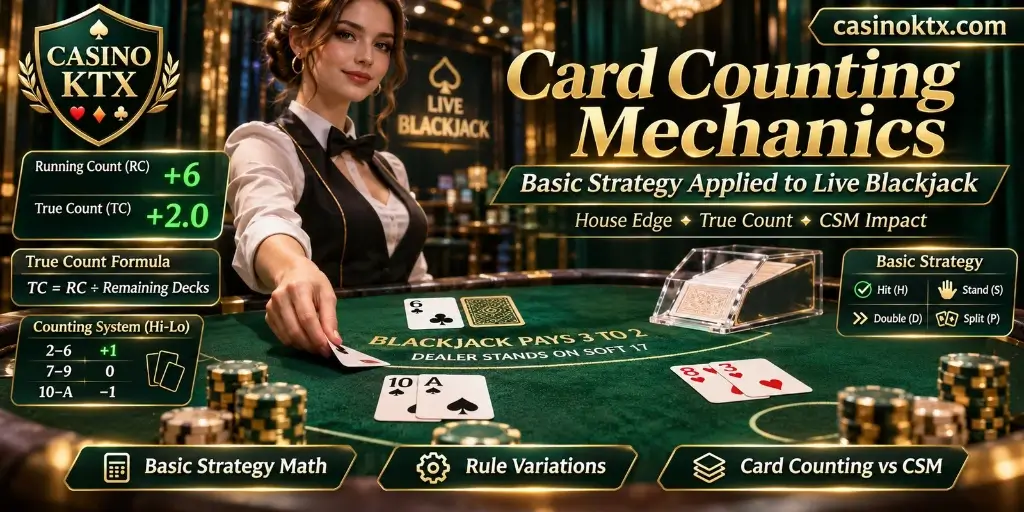
When evaluating live dealer table games from a quantitative perspective, Blackjack offers one of the lowest theoretical house edges in the casino—provided you execute mathematically optimal decisions on every hand. However, transferring traditional brick-and-mortar card counting into online live dealer studios introduces structural variables that alter expected value (+EV). Understanding live blackjack basic strategy math and the mechanics of card counting continuous shuffler systems separates disciplined probability modeling from flawed assumptions.
1. Deconstructing Blackjack House Edge Calculation
Every rule variation on a Blackjack table shifts the baseline mathematical expectation. Before applying any decision matrix or bankroll rule, you must compute the exact blackjack house edge calculation for the specific shoe rules in play.
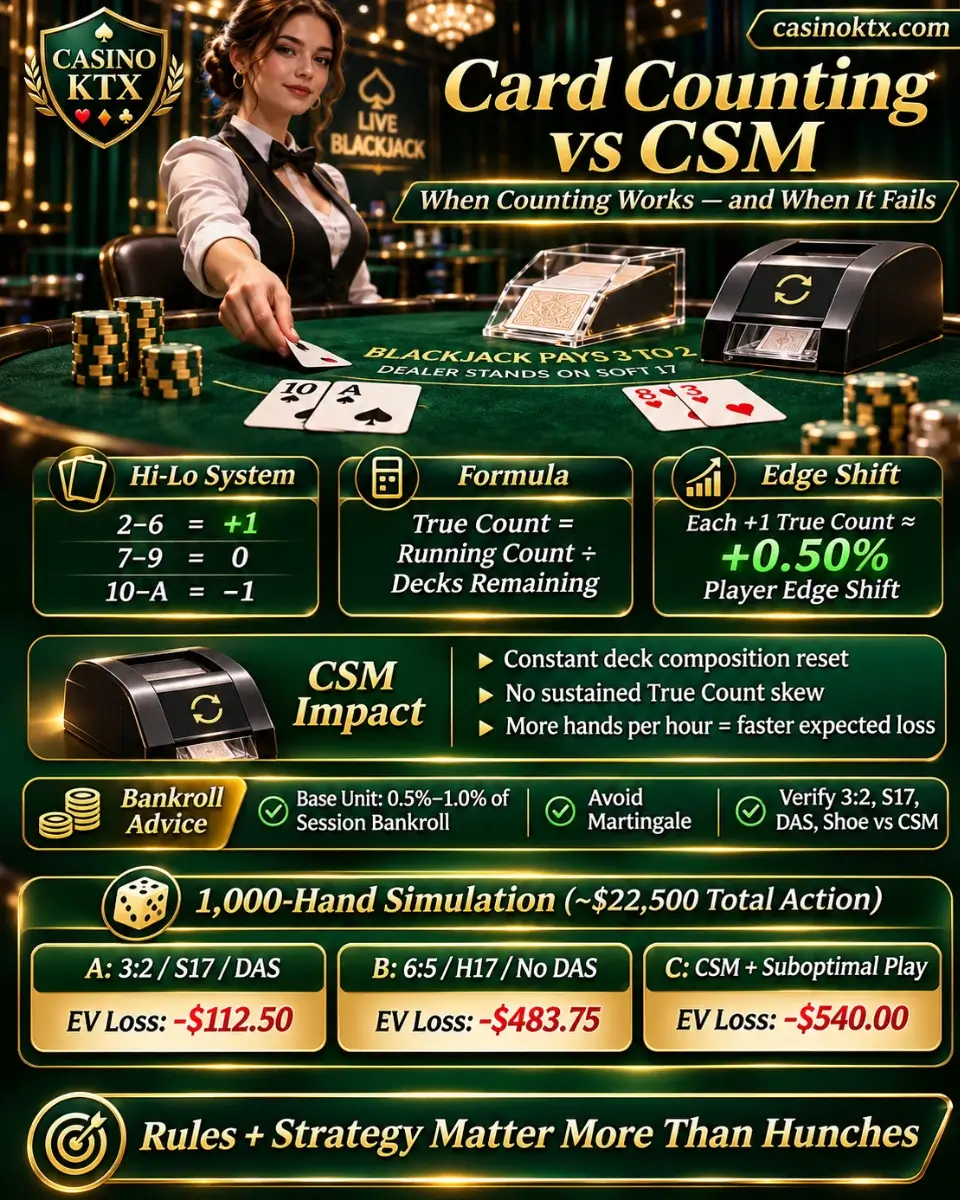
A baseline 6-deck or 8-deck game with standard rules—Dealer stands on all 17s (S17), Blackjack pays 3:2, Double After Split (DAS) allowed, and Resplit Aces (RSA) restricted—starts near a 0.50% to 0.65% house edge when played with exact basic strategy. Each rule alteration shifts that edge by a measurable percentage:
- Blackjack Payout 3:2 vs. 6:5: Dropping payout from 3:2 to 6:5 adds approximately +1.39% to the house edge—more than tripling the operator’s mathematical advantage.
- Dealer Hits Soft 17 (H17) vs. Stands on Soft 17 (S17): H17 adds roughly +0.20% to +0.22% to the house edge because the dealer improves weak hands more frequently.
- Double After Split (DAS) Allowed: Allowing DAS reduces the house edge by roughly -0.14% to -0.17%, giving the player higher expected value on split pairs like 2s, 3s, 6s, and 7s.
- Late Surrender Available: Surrendering unfavorable totals (such as 16 vs. Dealer 9, 10, or Ace) lowers house edge by roughly -0.08% to -0.10% in multi-deck shoes.
- Number of Decks (6 Decks vs. 8 Decks): Moving from 6 decks to 8 decks typically adds around +0.02% to +0.05% to the house edge due to slightly diluted natural blackjack frequency.
Example (6-Deck S17, DAS, 3:2): ~0.40% to 0.50% vs. (6:5, H17, No DAS): ~2.15%+
Rule Impact Matrix (6-Deck Baseline)
| Rule Parameter | Typical Table Setting | House Edge Shift | Net Effect on Player EV |
|---|---|---|---|
| Natural Blackjack Payout | 3:2 vs. 6:5 | +1.39% (if 6:5) | Severe negative EV drag if 6:5 |
| Dealer Soft 17 Rule | H17 vs. S17 | +0.21% (if H17) | Higher dealer completion rate |
| Double After Split (DAS) | Allowed vs. Restricted | -0.15% (if Allowed) | Improves split pair profitability |
| Surrender Option | Late Surrender vs. None | -0.09% (if Late) | Cuts losses in worst matchups |
| Shoe Depth | 6 Decks vs. 8 Decks | +0.03% (for 8 Decks) | Minor dilution of Ace/10 density |
2. Basic Strategy Math: Why Optimal Decisions Minimize Drag
Live blackjack basic strategy math is derived through computer simulations across hundreds of millions of hands to identify the highest-EV action—Hit, Stand, Double Down, Split, or Surrender—for every possible player total against every possible dealer upcard.
Unlike progression myths or intuition-based play, basic strategy does not predict the next card; it minimizes negative expected value per unit wagered. Deviation from basic strategy introduces avoidable mathematical leakage:
- Standing on 16 vs. Dealer 10 instead of Hitting (or Surrendering): Because the dealer holds a strong 10 upcard (roughly a 30.8% chance of a 20 total and ~23.1% bust rate depending on rules), standing on 16 yields a lower EV than hitting or surrendering over large samples.
- Not Splitting Aces or 8s: Splitting Aces creates two separate hands starting with 11-value potential, while splitting 8s converts a notoriously weak 16 total into two starting hands of 8—avoiding the worst starting hand in Blackjack.
- Missing Profitable Doubles (e.g., 11 vs. Dealer 6 or 10 vs. Dealer 9): Doubling down when statistical advantage or favorable deck composition supports higher wager exposure captures extra EV on high-probability improvement hands.
In a standard 6-deck S17/DAS game (0.50% house edge under basic strategy), pure execution yields an expected loss of just -$50.00 per $10,000 wagered. Frequent emotional deviations—such as refusing to hit stiff hands out of fear of busting—can easily push the effective house edge to 1.80%–2.50%+, multiplying capital erosion by 3x to 5x. Similarly, understanding how wager requirements interact with low-edge games is critical when evaluating promotional offers, as detailed in our guide on how to beat casino bonuses mathematically.
3. Card Counting Mechanics & The Continuous Shuffler Reality
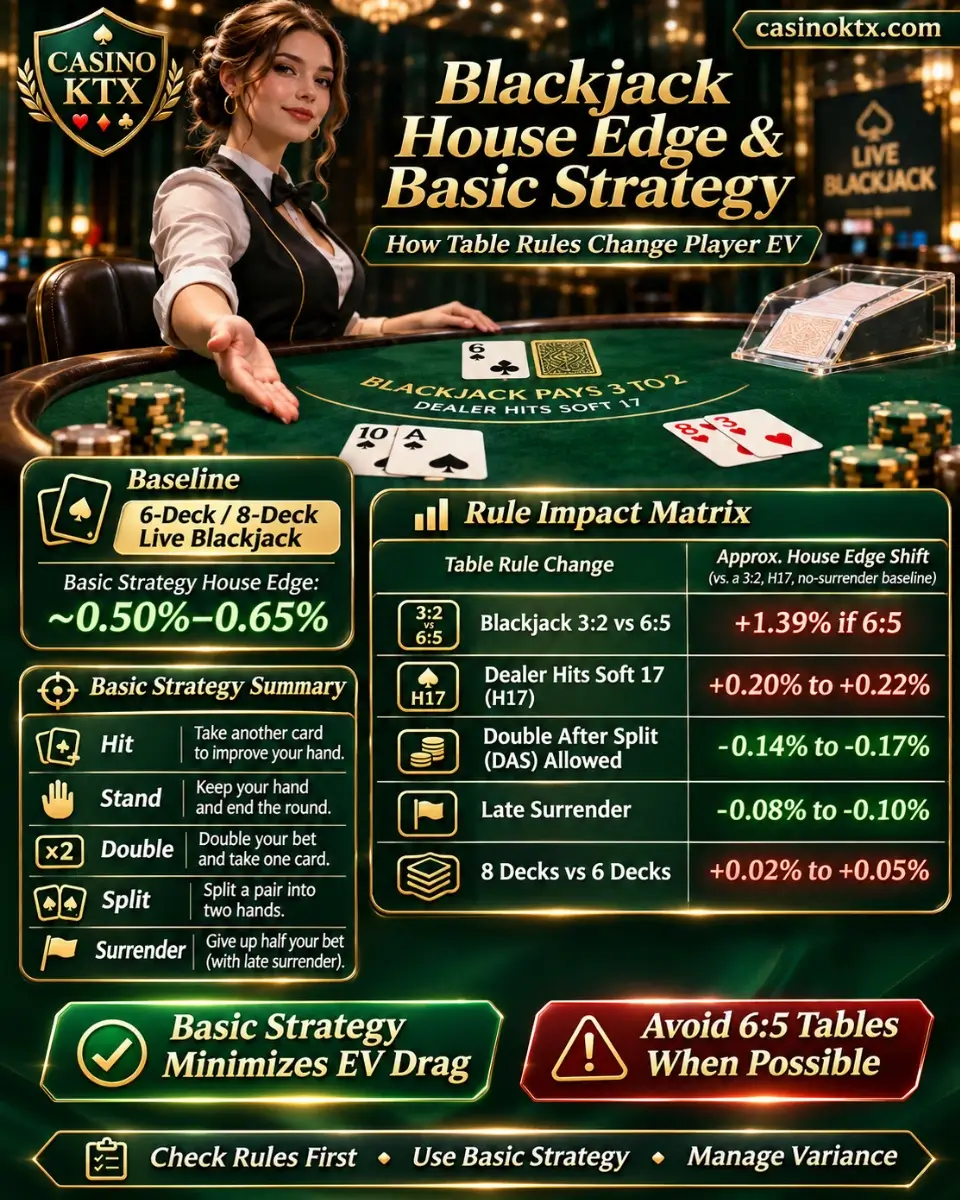
Traditional card counting—such as the Hi-Lo System—assigns point values to cards as they leave the shoe to track remaining high-card density:
- Low Cards (2, 3, 4, 5, 6): +1 (favor the dealer when depleted because small cards help dealers complete stiff hands like 12–16 without busting).
- Neutral Cards (7, 8, 9): 0
- High Cards (10, J, Q, K, Ace): -1 (favor the player when concentrated in the remaining shoe because more 10-value cards increase natural Blackjacks and dealer bust rates).
Each +1 True Count shifts player advantage by approximately +0.50% in multi-deck shoes.
Why Card Counting Breaks Down Against a Continuous Shuffler (CSM)
In live dealer studio environments, many high-volume tables utilize a Continuous Shuffling Machine (CSM) rather than a manual shoe with deep cut-card penetration. Understanding card counting continuous shuffler dynamics explains why counting fails on these tables:
- Constant Deck Composition Reset: A CSM continuously feeds played cards back into the shuffling reservoir after each round or batch. Instead of the remaining deck becoming progressively richer in 10s and Aces, composition stays near its baseline statistical average.
- Elimination of True Count Skew: Because you cannot track meaningful deck depletion or accumulate a sustained positive True Count, your statistical edge rarely shifts into positive territory (+EV).
- Higher Hands-Per-Hour Drag: CSM tables eliminate shuffle breaks, increasing hands dealt per hour. While this speeds up action, a higher volume of hands under a negative house edge simply accelerates expected mathematical loss (Volume × House Edge).
4. Risk Management & Bankroll Modeling for Live Blackjack
Even when executing basic strategy on a favorable 3:2 table, short-term variance in Blackjack is substantial. Because doubling down and splitting pairs increase average wager exposure to roughly 1.12x–1.15x your base unit per round, standard deviation swings can be sharp during negative runs.
Practical Bankroll Sizing Rules
- Controlled Unit Sizing: Keep base wagers between 0.5% and 1.0% of your dedicated session bankroll (or up to 1.5% only with strict stop-loss limits). If you apply disciplined unit sizing similar to the flat betting formula for live Baccarat, you insulate your bankroll against sudden tail-event downswings.
- Avoid Martingale Progressions: Doubling wagers after every loss collides rapidly with table maximum caps and finite bankroll depth during 7-to-9 hand losing streaks.
- Audit Table Rules Before Seating: Always verify 3:2 vs. 6:5 payout, S17 vs. H17, DAS, and manual shoe vs. CSM before placing your first chip.
5. 1,000-Hand Live Blackjack Simulation ($20 Base Unit)
To illustrate how table rules and decision precision impact real liquidity, consider a simulated 1,000-hand session using a $20.00 base unit (factoring in doubles and splits that bring total wagered volume to approximately $22,500):
Key Analytical Takeaways: Across live casino tables in Southeast Asia—including players in Thailand, Indonesia, Malaysia, Vietnam, and Singapore—selecting a 3:2 S17 manual-shoe table and adhering strictly to basic strategy saves hundreds of dollars per 1,000 hands compared to 6:5 or CSM tables.
Explore More Data-Driven Casino & Probability Guides on CASINOKTX:
While basic strategy and probability math reduce unnecessary house edge and manage session risk, no strategy can guarantee profit or eliminate the casino’s mathematical advantage over time. Treat live casino play strictly as paid entertainment, set clear loss limits before you start, and never wager money needed for essential financial obligations. If gambling stops feeling controlled or becomes stressful, pause immediately and seek support from a qualified helpline.