
Dragon Tiger Probability: Mathematical Breakdown of Single-Card Gaming

Often described as two-card Baccarat stripped down to its bare essentials, Dragon Tiger eliminates third-card drawing rules, natural totals, and complex commission structures. Instead, a single card is dealt to the Dragon position and a single card to the Tiger position, with the highest rank winning (Ace low, King high). While its rapid 15-to-20-second round cycle appeals to high-tempo live dealer audiences across Southeast Asia—including Thailand, Indonesia, Malaysia, Vietnam, and Singapore—the underlying mathematics tell a very specific story about expected value (+EV). Applying a rigorous dragon tiger probability strategy requires evaluating exact card-removal combinatorics, understanding why dragon tiger tie bet odds create severe bankroll drag, and comparing single card baccarat math against traditional multi-card table games.
1. Combinatorial Probability in an 8-Deck Shoe
Standard live dealer studios—such as Evolution, Pragmatic Play Live, Playtech, and SA Gaming—typically deal Dragon Tiger from an 8-deck shoe containing 416 cards (with a cut card placed roughly 1 to 1.5 decks from the end). Because only two cards are drawn per round without replacement, calculating exact probabilities at the top of a fresh shoe is a straightforward combinatorial exercise.
- Total Cards in Shoe (N): 416 cards (8 decks × 52 cards)
- Cards per Rank (Ace through King): 32 cards (8 decks × 4 suits)
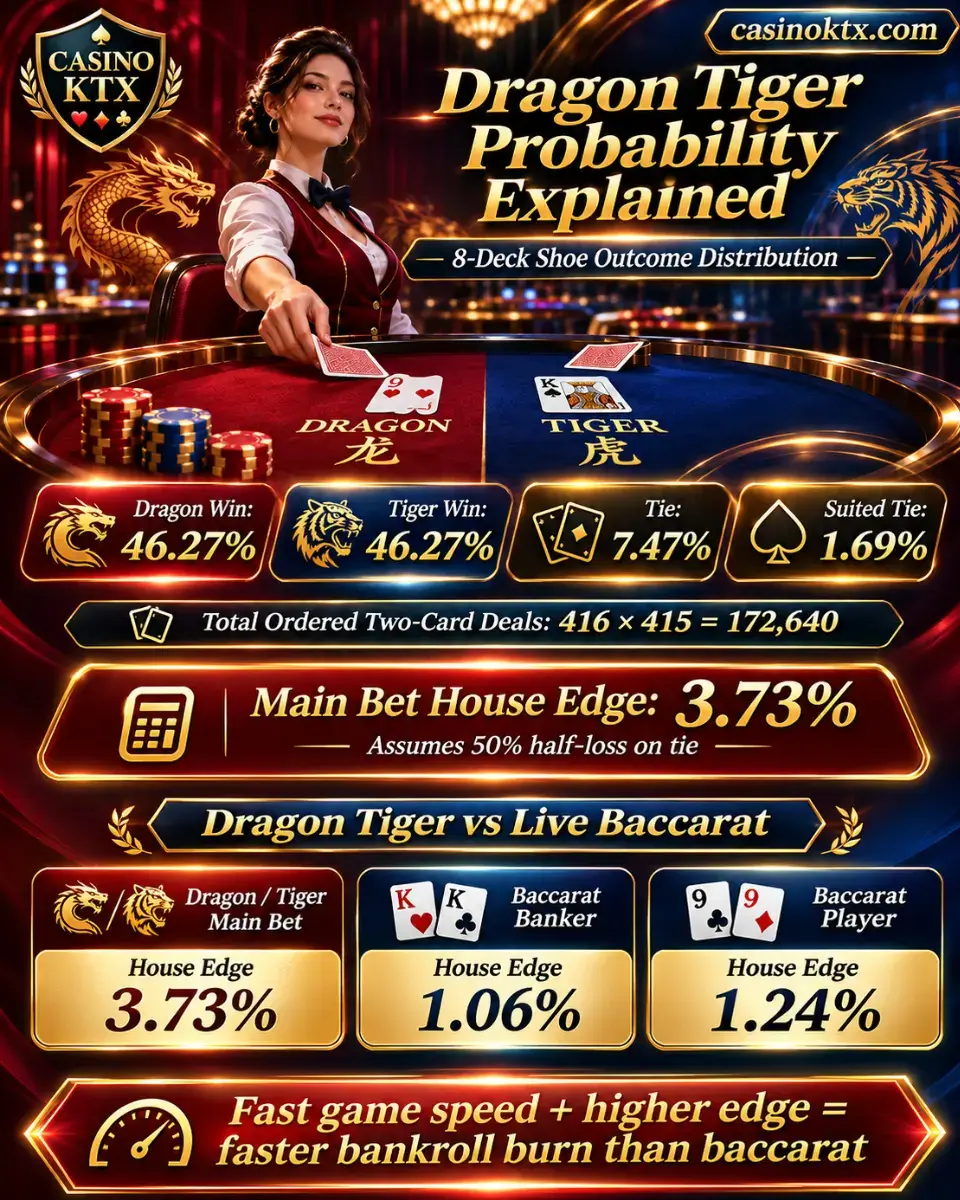
- Total Ordered Two-Card Deals: 416 × 415 = 172,640 permutations
Because card ranks are symmetrical, Dragon and Tiger hold identical baseline win rates.
Baseline Outcome Distribution Table (8-Deck Shoe)
| Bet Outcome | Exact Fraction | Probability (%) | Standard Payout | Tie Rule Impact |
|---|---|---|---|---|
| Dragon Win | 192 / 415 | 46.2651% | 1:1 | N/A |
| Tiger Win | 192 / 415 | 46.2651% | 1:1 | N/A |
| Tie (Same Rank) | 31 / 415 | 7.4699% | 8:1 or 11:1 | Lose 50% of main bet |
| Suited Tie | 7 / 415 | 1.6867% | 50:1 | Lose 50% of main bet |
2. Single Card Baccarat Math: House Edge Formulas
Unlike standard Baccarat—where Banker wins 45.86% of hands and incurs a 5% commission—single card baccarat math is completely symmetrical between the two main positions. However, the house derives its mathematical advantage from a single rule: when a Tie occurs, main wagers on Dragon or Tiger lose half (50%) of their stake (while a few non-standard tables enforce a 100% full loss on Ties, doubling the house edge).
Resulting in a fixed 3.73% Theoretical House Edge (or 7.47% under Full-Loss Tie rules).
Dragon Tiger vs. Live Baccarat: Mathematical Comparison
| Mathematical Metric | Dragon Tiger (Standard) | Live Baccarat (Banker) | Live Baccarat (Player) |
|---|---|---|---|
| Win Probability | 46.27% | 45.86% | 44.62% |
| Tie / Push Handling | 7.47% (Lose 50%) | 9.52% (Full Push 0%) | 9.52% (Full Push 0%) |
| Commission on Win | 0% (1:1 Payout) | 5% (0.95:1 Payout) | 0% (1:1 Payout) |
| Theoretical House Edge | 3.73% | 1.06% | 1.24% |
| Rounds Per Hour (Avg.) | 120 – 150 hands/hr | 55 – 75 hands/hr | 55 – 75 hands/hr |
Critical Analytical Insight: Although Dragon Tiger pays 1:1 with zero commission on wins, its 3.73% house edge is more than 3.5× higher than a standard Banker wager in Live Baccarat (1.06%). If your priority is minimizing mathematical house drag on 1:1 table games, reviewing our full breakdown of the mathematical reality of live Baccarat commission demonstrates why paying a 5% commission still leaves you far ahead of commission-free single-card alternatives.
3. Auditing Dragon Tiger Tie Bet Odds & Side Wagers
Many recreational players chase high multipliers on Tie, Suited Tie, Big/Small, or Odd/Even side bets. Evaluating dragon tiger tie bet odds exposes extreme negative expected value across every secondary market on the layout:
- Standard Tie Bet (8:1 Payout — Most Studios): With a 31/415 (7.47%) win probability and a 384/415 (92.53%) loss probability, the expected value is [(31 × +8) + (384 × -1)] / 415 = -136 / 415, yielding an extreme 32.77% house edge.
- Standard Tie Bet (11:1 Payout — Select Studios): Even where studios upgrade payouts to 11:1, the house edge remains 10.36% (-43 / 415).
- Suited Tie Bet (50:1 Payout): Out of 31 remaining matching ranks in an 8-deck shoe, only 7 share the identical suit (7 / 415 = 1.69% probability). At 50:1, EV equals [(7 × +50) + (408 × -1)] / 415 = -58 / 415, creating a 13.98% house edge.
- Big / Small & Odd / Even Side Bets (1:1 Payout): Bets on Big (8–King: 192 cards) or Small (Ace–6: 192 cards) automatically lose whenever a 7 is dealt (32 cards), resulting in a 7.69% house edge (32 / 416 = 1/13).

4. Card Counting & Shoe Skew in Dragon Tiger
Because Dragon Tiger is dealt from a physical 8-deck shoe without replacement, card removal alters remaining deck composition—yet practical exploitation remains mathematically blocked:
- Main Bet Symmetry Cannot Be Broken Pre-Deal: Removing high cards (Kings, Queens, Jacks) or low cards (Aces, 2s, 3s) changes conditional win probabilities only if one card is already visible—which is impossible before betting closes. Prior to the deal, Dragon and Tiger stay 100% symmetrical.
- Tie Bet Cut-Card Penetration Barrier: A Tie bet only approaches positive expected value when specific ranks become heavily concentrated near the bottom of a shoe. Because studios place the cut card 60 to 80 cards from the end, penetration never reaches the threshold needed to overcome a 32.77% (or 10.36%) house edge.
- Scoreboard / Bead Road Illusion: Tracking historical streaks (“Dragon runs” or “Alternating patterns”) has zero predictive power because each two-card draw from a shuffled shoe retains independent directional symmetry.
5. Hourly Burn-Rate & Session Simulation ($20 Base Unit)
Because Dragon Tiger deals roughly 135 hands per hour—more than double the pace of Live Baccarat—session velocity dramatically accelerates bankroll erosion. Consider a 2-hour live session (270 total hands) using a flat $20.00 base unit ($5,400 total wagered volume):
Actionable Bankroll & Risk Control Guidelines
- Restrict Wagers Strictly to Main Positions: Never allocate capital to the 8:1 Tie (32.77% edge), Suited Tie (13.98% edge), or Big/Small (7.69% edge) markets.
- Adjust Unit Sizing for Deal Velocity: Keep base wagers between 0.5% and 1.0% of session capital and enforce a hard hand-count cap (such as 100 hands) rather than open-ended time play. Pairing strict unit caps with disciplined staking—similar to the flat betting formula for live Baccarat—protects your bankroll against rapid high-speed variance.
- Verify Table Tie Rules First: Confirm that the studio applies the 50% half-loss rule on Ties rather than a 100% full-loss penalty before placing your first chip.
Explore More Mathematical Table & Slot Guides on CASINOKTX:
While probability math and house edge comparisons help minimize unnecessary capital erosion, no betting system can overcome the casino’s built-in mathematical advantage over time. Because Dragon Tiger deals over 120 rounds per hour, bankroll swings happen rapidly. Treat live gaming strictly as paid entertainment, establish firm stop-loss and round limits before playing, and never wager funds needed for essential living expenses. If gaming stops feeling controlled, step away immediately and seek support from a certified helpline.